

burrow blog

Field notes from the burrow

Guardrails, rollbacks, and the craft of operating real apps on a cluster you own. Written for developers moving fast with AI who do not want to break things.

Engineering

The cheap VPS setup: turn one machine into a cluster you operate from your laptop

A real cluster does not cost 60 to 100 dollars a month. A single small VPS running k3s is a genuine cluster, and Burrow runs on it the same way it runs on a big managed one.

Engineering

Moving from a PaaS to your own cluster: a practical migration guide

You have outgrown your PaaS on cost and lock in, and moving to a cluster you own sounds like a weekend of pain. Here is the real path, ten steps, honest about the work.

Engineering

Connect the logs and metrics you already run

If you already run Loki or Prometheus, you do not have to install a second stack next to it. Burrow can connect to what you have and query it in plain language.

Engineering

Add a cache to speed up your site, start to finish

A cache stores the results of slow or repeated work so you can serve them fast. Here is when it helps, when it does not, and the full workflow to add one to your app.

Product

Autoscaling, done safely: a floor, a ceiling, and no surprises

Autoscaling should add copies of your app when traffic rises and remove them when it falls, between a floor so you are never caught at zero and a ceiling so a spike can never scale you into a surprise bill.

Engineering

Kubernetes, explained by actually deploying an app

The clearest way to understand Kubernetes is to deploy one small web app on it by hand. Here is every piece you touch, explained plainly, and where the weight really lands for a solo developer.

Engineering

Why Burrow ships a composable CLI, not an MCP server

Loading an MCP server into your agent's session puts its whole tool list in context, every turn. For an operations surface with many verbs, a CLI the agent runs on demand fits better. Here is the honest case.

Company

The audit log: 7 things it tells you about what your agent did

When an agent operates your infrastructure, you should never have to take its word for what happened. The audit log is the record that lets you check.

Engineering

Run migrations, seeds, and one off tasks with burrow run

Every app needs the occasional one off command: a migration, a seed, a cleanup script. Here is how to run one in your app's own environment, cleanly.

Product

Put your app on the internet: a domain and HTTPS, step by step

Take a deployed app from running only inside the cluster to live at your own domain over HTTPS, and diagnose it link by link when something is not ready.

Engineering

Config and secrets, the practical guide

How to set, update, and manage your app's configuration and sensitive values, with a clean line between the two and no restarts you did not ask for.

Engineering

Give your AI agent access to your server without handing over the keys

How Burrow lets an agent operate your live apps while it holds no cluster credentials, never carries your code, and cannot reach past the lines you draw.

Company

Self host or PaaS? 8 questions for the solo developer

A PaaS runs your app on their platform. Self hosting runs it on yours. Eight honest questions to figure out which one you actually want right now.

Product

A day operating an app through your agent, start to finish

What it actually feels like to run a live app by talking to your agent: deploy, diagnose, fix, and keep control of the moves that matter.

Product

Staging and prod, one workflow: how environments work in Burrow

Keep a loose place to move fast and a locked down place that stays safe, with the same commands across both. A practical guide to environments.

Engineering

Read your logs and metrics without wiring up a monitoring stack

See what your app is doing and how it is performing, without assembling a full observability platform first. A guide to logs and metrics in Burrow.

Product

Attach Postgres to your app in one command, with backups you can trust

Give your app a real database, wired in for you, plus a straightforward way to take and restore backups. A practical guide to the Postgres addon.

Engineering

What deploy by image reference means, and why we built it that way

Burrow deploys your app by naming an image, not by taking your code. Here is what that means in practice and why it makes deploys safer and clearer.

Product

7 Kubernetes chores Burrow does so you never touch them

The unglamorous operational work that stands between your code and a running app, and how Burrow takes each piece off your plate.

Engineering

From an empty cluster to a live app: your first deploy

A start to finish walkthrough: install Burrow, deploy your app by image reference, check that it is healthy, and put it on the internet over HTTPS.

Engineering

Guardrails, explained: how an agent operates prod without breaking it

Approvals, denials, and warm rollbacks: the mechanisms that let Burrow hand an AI agent the keys to prod, safely.

Changelog

One-command rollback is now the default

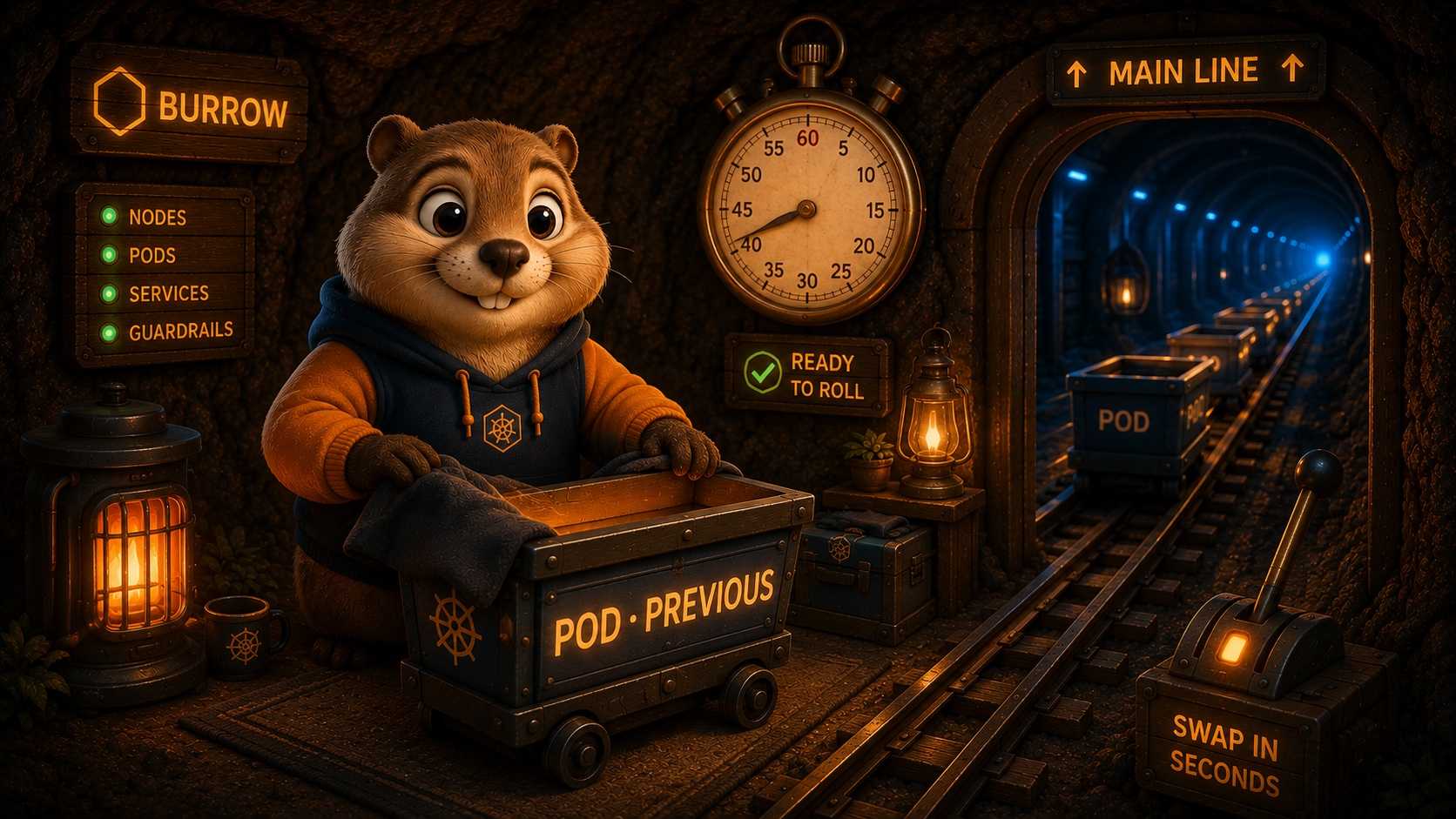
Every deploy keeps the previous revision warm for 24 hours. Roll back with a single command, no rebuild, no cold start.

Company

You keep root. We never phone home.

Our stance on data, telemetry, and lock in, and the choices that make self hosted mean what it says.

Product

Approvals that don't slow you down

Sign off gates that batch, remember your intent, and never block a deploy that stays inside its limits.

Engineering

Warm rollbacks: turn a bad deploy into a 40 second fix

Keeping the previous revision warm turns a bad deploy into a fast fix. Here is how it works, with an illustrative walk through.

Product

Our CLI is a first class surface, not an afterthought

The terminal is where developers already live. Every guardrail, approval, and rollback is one legible command away.